
How to Improve Your Google Ads Quality Score
By Adrian Chromenko, primarydm.com·November 23, 2026·7 min read
Quick answer
Quality Score is Google's 1 to 10 rating for each keyword, built from expected clickthrough rate, ad relevance and landing page experience. To see it, open Search keywords, click the columns icon and add the Quality score columns. Then fix whichever part is Below average: use the searcher's words in your ad, give people a specific reason to click, and send the click to a fast page about that exact service.
Quality Score is Google's 1 to 10 rating of how well a keyword, its ad and its landing page fit what people search for. A low score doesn't stop your ads by itself, but it points at what's holding them back. The good news is that each part of it has a clear fix. Watch the video above, or follow the steps below.
What Quality Score is (and isn't)
Google gives each keyword a Quality Score from 1 to 10. It's built from three parts, each rated Above average, Average or Below average compared with other advertisers whose ads showed for the exact same search:
- Expected clickthrough rate (CTR): how likely people are to click your ad when it shows for that keyword.
- Ad relevance: how closely your ad matches what the person searched for.
- Landing page experience: how relevant and useful your page is to people who click.
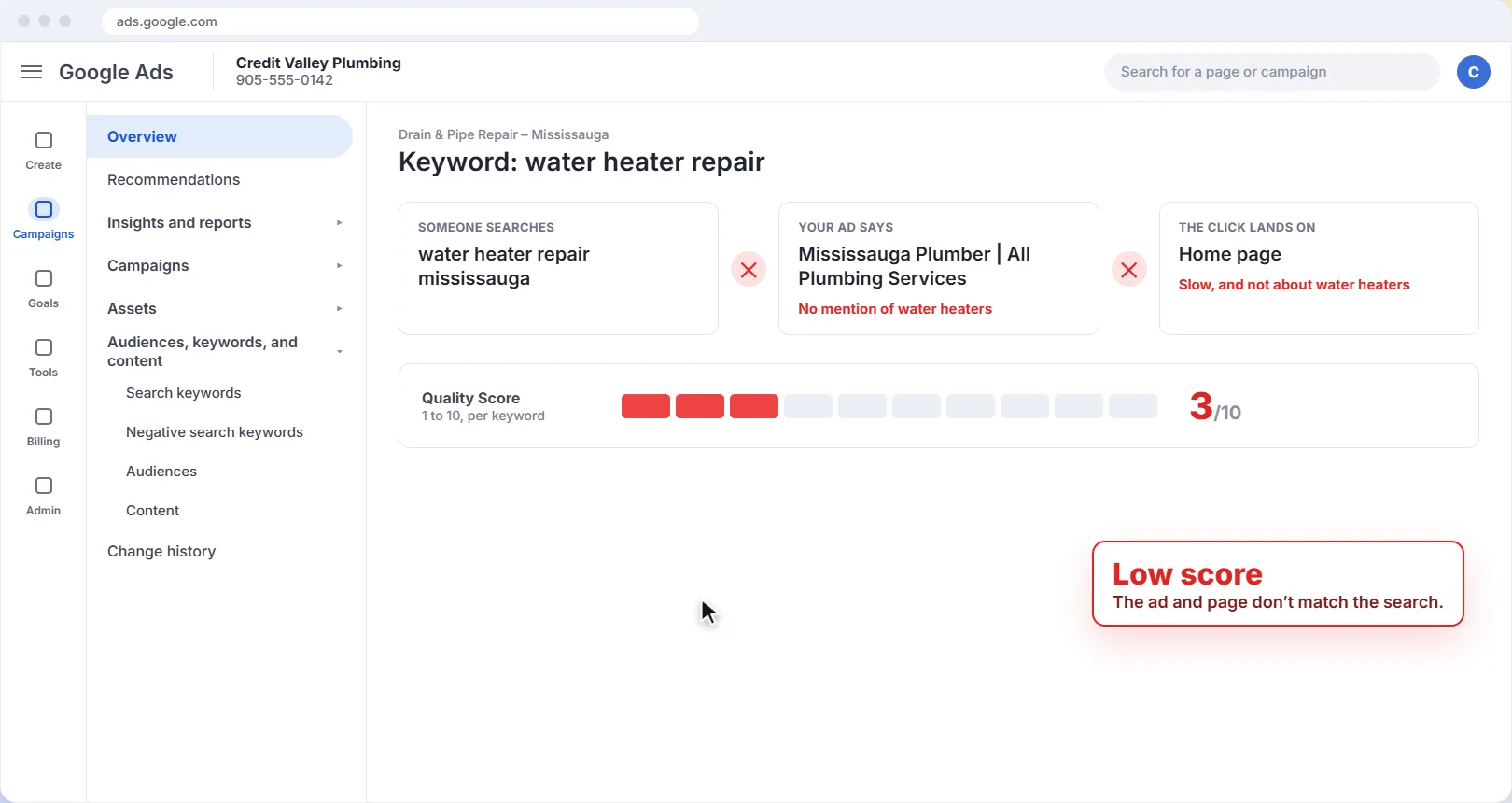
Google is clear that Quality Score is a diagnostic tool, not an input in the ad auction and not a number to chase. Think of it like a warning light: it tells you which of the three parts to look at. The score itself is not what you improve; better ads and pages are.
How to check your Quality Score
1Open your Search keywords
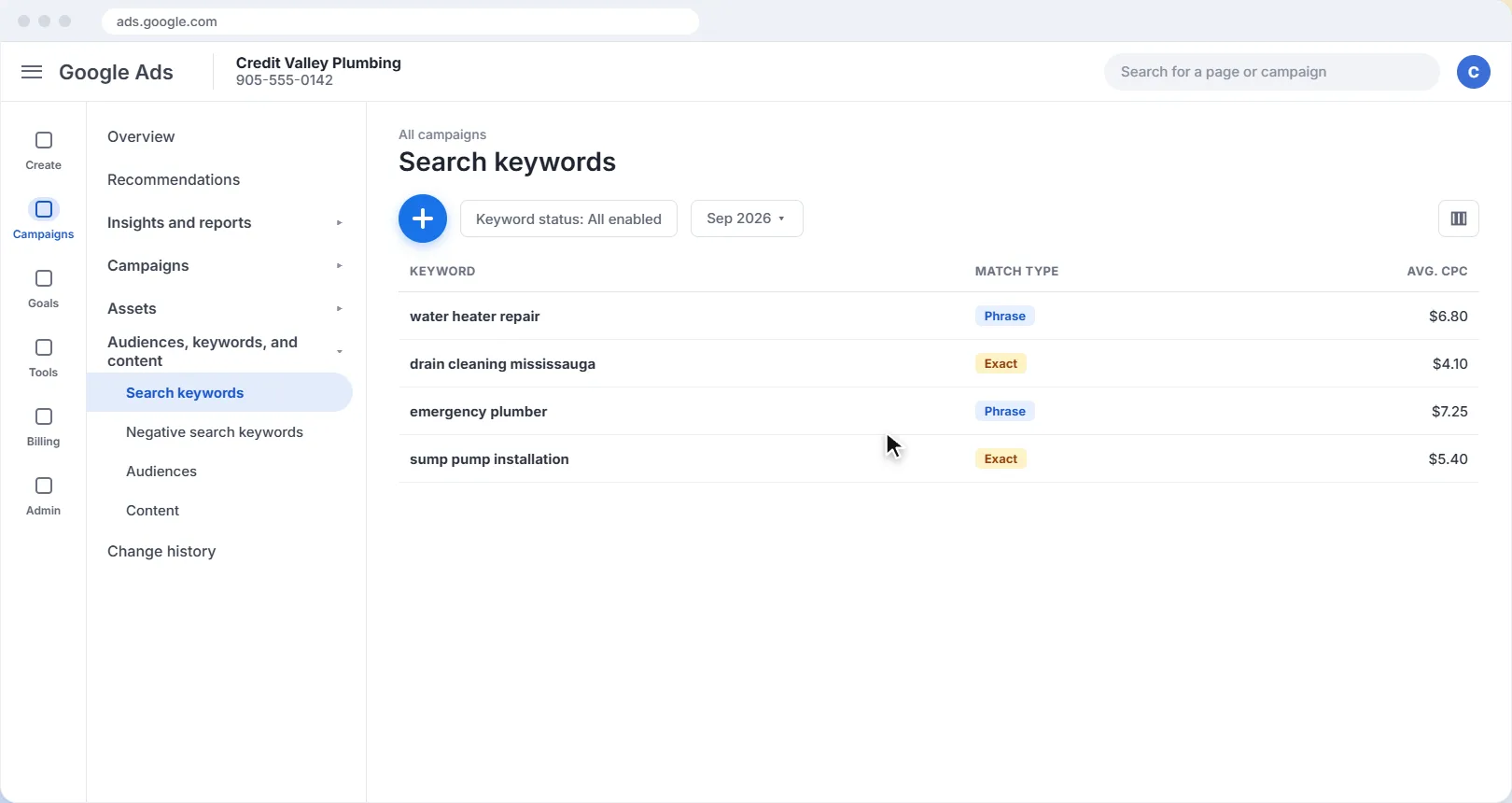
In the left menu, open Audiences, keywords, and content and click Search keywords. (Google's own steps call this the Keywords page in the Campaigns menu; it's the same table.)
2Add the Quality Score columns
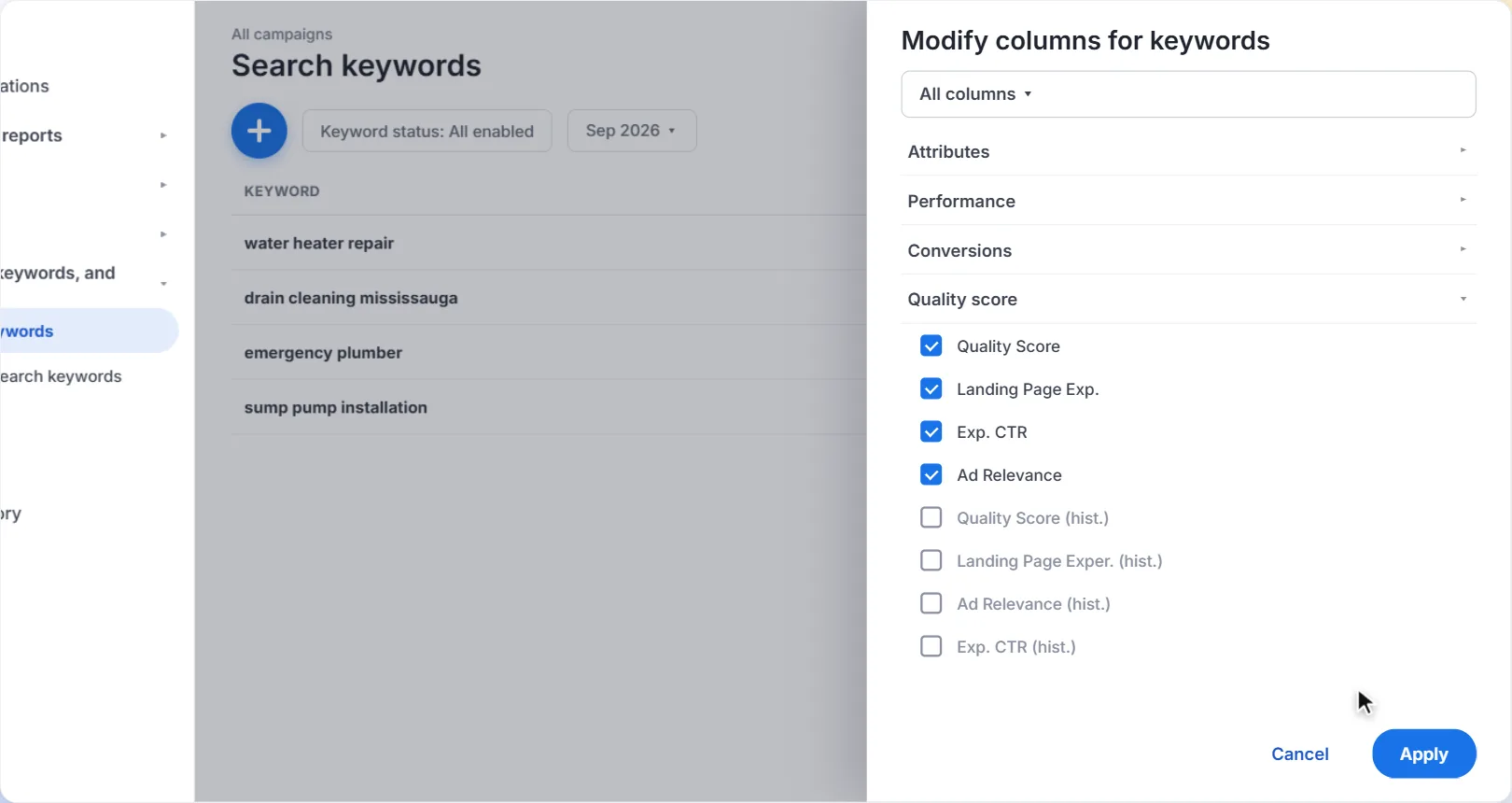
Quality Score isn't shown by default. Click the columns icon above the table. Under Modify columns for keywords, open the Quality score section and tick Quality Score, Landing Page Exp., Exp. CTR and Ad Relevance, then click Apply.
The (hist.) versions show the score over the date range you pick, which is useful later for seeing whether your changes helped.
3Read the three parts and start with "Below average"
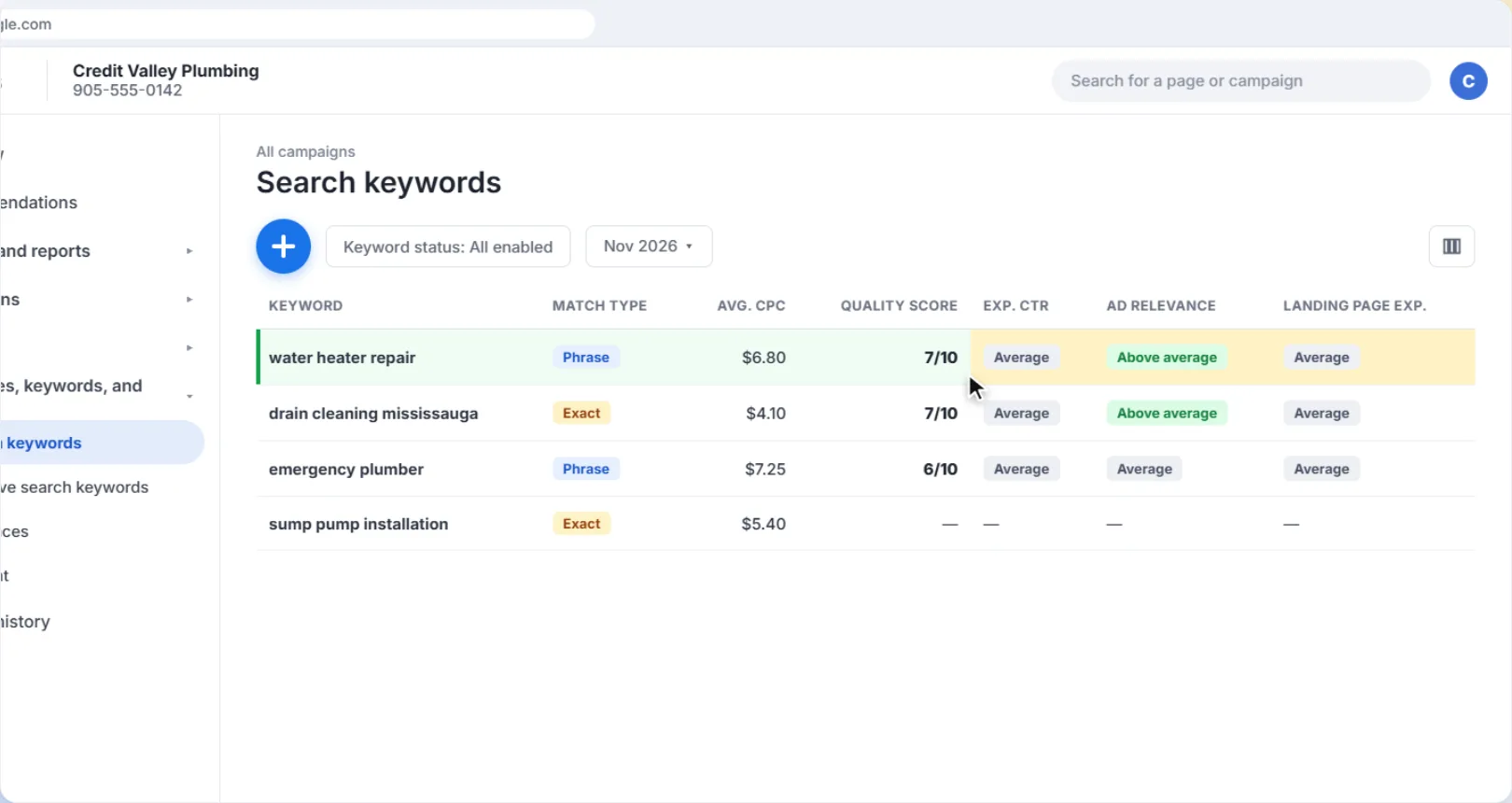
Each keyword now shows its score and the three parts. Look for the ones marked Below average: that's where the fix is. In this example, "water heater repair" scores 3/10 with all three parts below average, while "drain cleaning mississauga" scores 7/10.
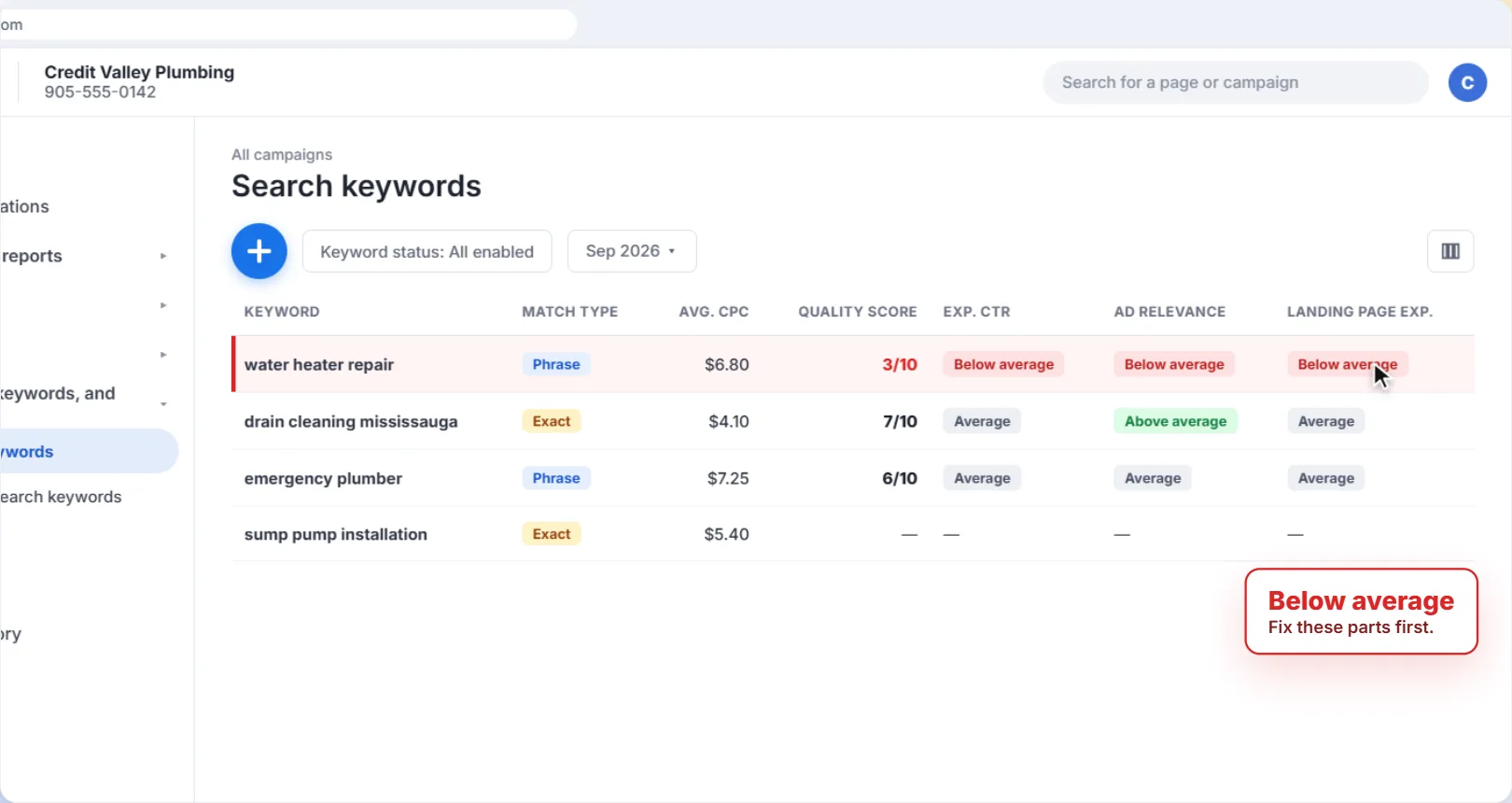
See a dash (—) instead of a score? That means there haven't been enough searches that exactly match the keyword to give it a score yet. It isn't a problem. Check back once the keyword has more impressions.
How to improve each part
| Below average on… | Usually means | Fix |
|---|---|---|
| Ad relevance | The ad doesn't use the searcher's words, or one ad group covers unrelated services. | Put the keyword's words in your headlines. Split mixed ad groups by service. |
| Expected CTR | The ad is vague, so people skip it for a competitor's. | Be specific: what you do, where, and why you. Add a call to action and call assets. |
| Landing page exp. | The click lands on a slow or general page. | Send it to a fast, mobile-friendly page about that exact service. |
4Ad relevance: use the words people search for
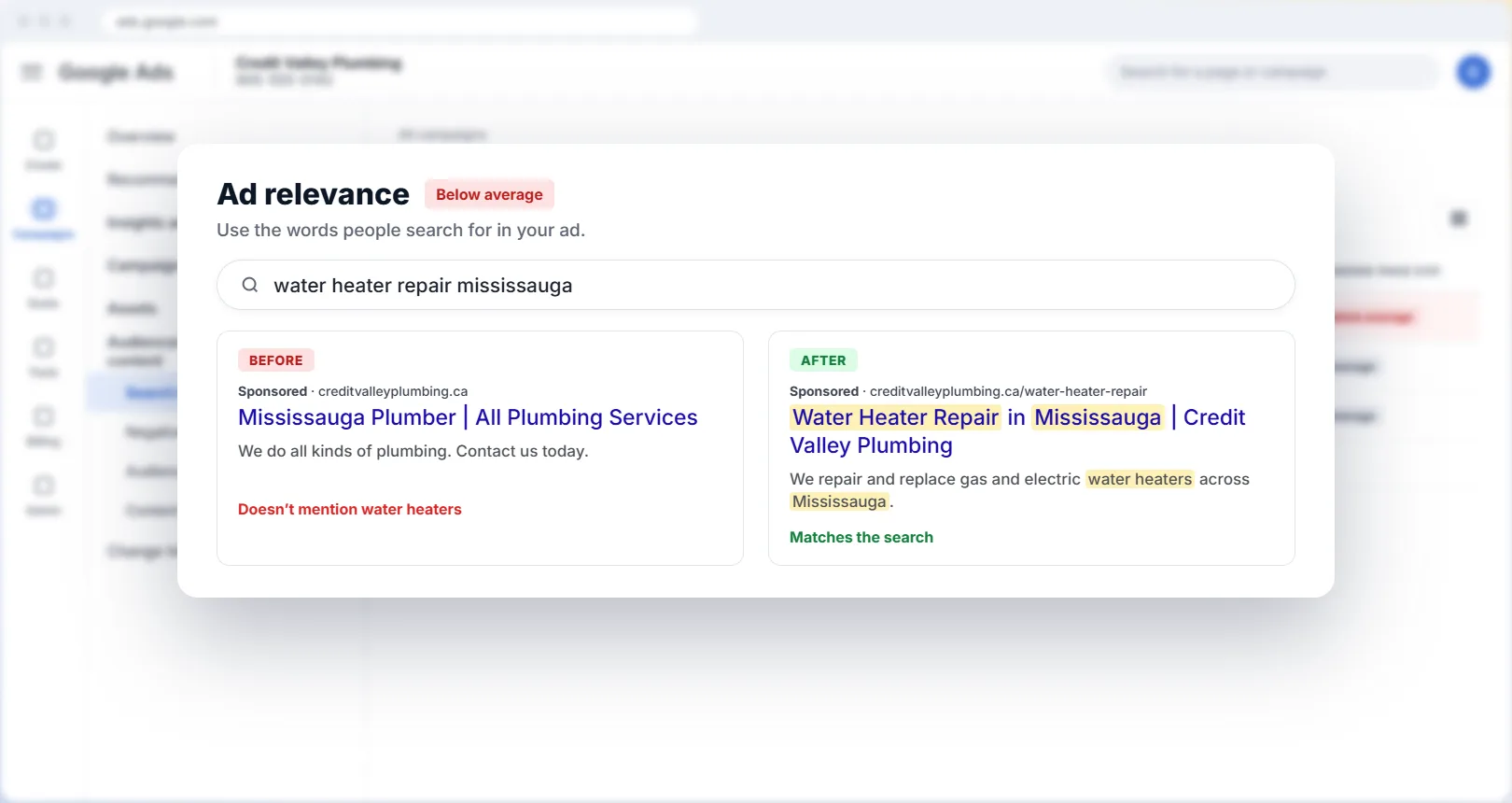
If someone searches "water heater repair mississauga" and your ad says "Mississauga Plumber | All Plumbing Services", it doesn't look like the answer. Use the searcher's words in your headlines: Water Heater Repair in Mississauga.
If one ad group holds keywords for very different services, like water heaters, drains and bathroom renovations, no single ad can match them all. Split them into ad groups by service, each with its own ads. Your keyword match types matter here too: broad keywords can match searches your ad was never written for.
5Expected CTR: give people a reason to click
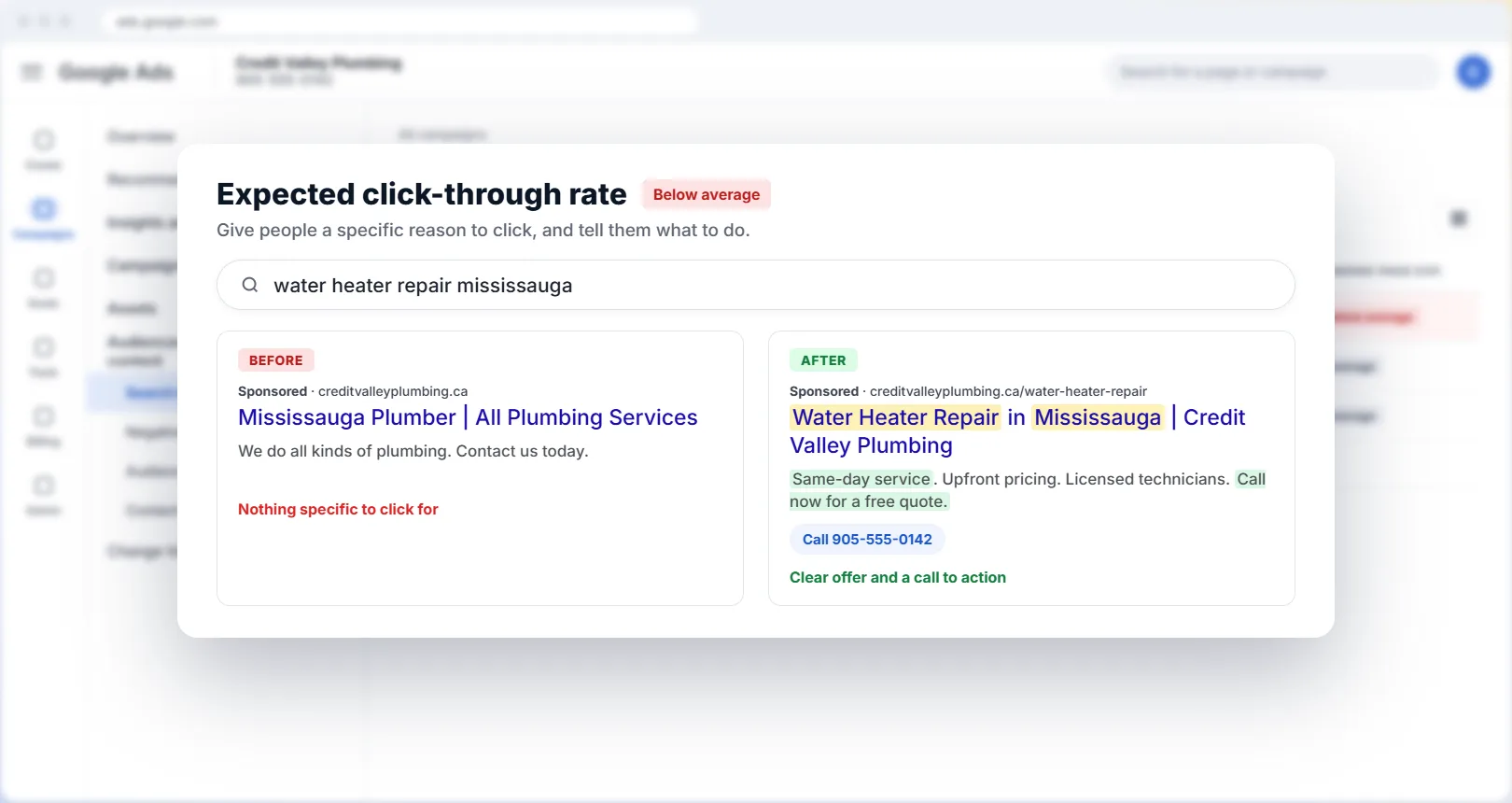
Make your ad the obvious one to click. Be specific about what you offer, mention what sets you apart (same-day service, upfront pricing, licensed technicians), and tell people what to do next: Call now for a free quote. Adding a call asset gives mobile searchers a call button right in the ad. For more on writing headlines and descriptions, see how to write Google Ads.
6Landing page experience: send the click to the right page
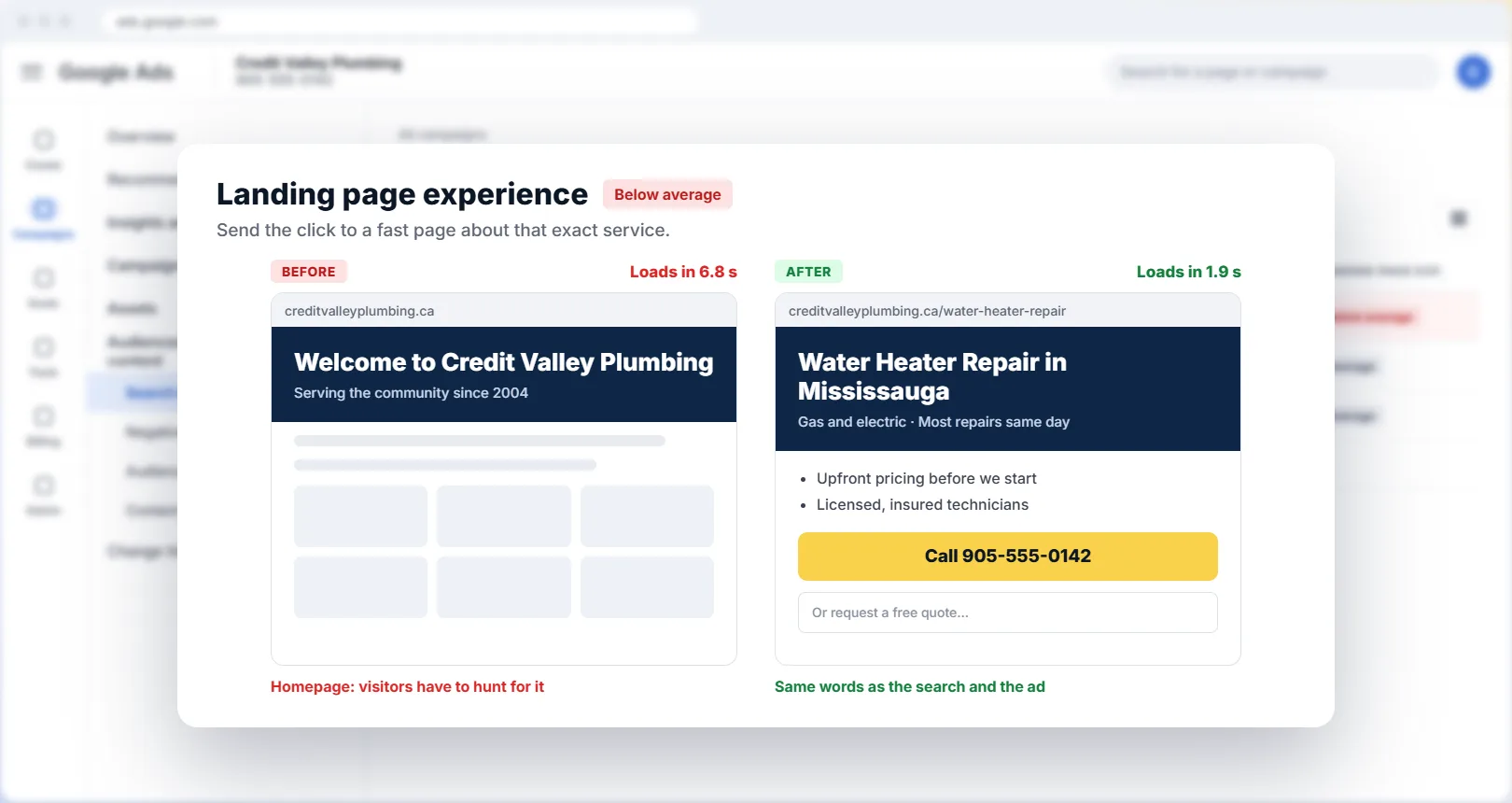
Don't send every click to your homepage. Send people searching for water heater repair to a page about water heater repair, with the same words as the ad, a phone number they can tap and a short form. Make sure it works well on a phone and loads quickly. If your site feels sluggish, start with why your website is slow.
7Give it a few weeks, then check again
Scores are based on past searches, so they don't change overnight. After a few weeks, check the columns again, or use the (hist.) columns with a date range to compare before and after.
Don't chase the number. Quality Score is a diagnostic. What matters is whether the clicks turn into calls and forms, so track your conversions and judge changes by cost per lead. A page that scores well but doesn't convert still needs work: compare yours with typical conversion rates by industry.
A few more tips
- Fix the biggest spenders first. A low score on a keyword that gets most of your clicks matters more than one that barely runs.
- Check the actual searches. The search terms report shows what people really typed. Block the irrelevant ones with negative keywords.
- Don't change match types to game the score. Quality Score is based on searches that exactly match the keyword, so switching match type doesn't change it.
- Ads not showing at all? That's usually a different problem. See why your Google Ads aren't showing.
Want ads and pages that match?
Our Google Ads management covers the whole path: keywords grouped by service, ads written for each one, and fast landing pages built by our own developers.
See our Google Ads managementThe screens in this guide are simplified illustrations of Google Ads; Google updates its layout often, so labels may differ slightly in your account. Google's own guides: About Quality Score for Search campaigns and 5 ways to improve your Quality Score. The plumbing business, keywords, scores and load times are examples.
Frequently asked questions
What is a good Quality Score in Google Ads?
There's no target number to hit. Higher scores usually mean all three parts are average or better, and low scores of 1 to 4 usually mean at least one part is below average. Google calls Quality Score a diagnostic tool, so use it to find what to fix rather than as a goal. What matters most is whether clicks turn into calls and forms.
What are the three Quality Score factors?
Expected clickthrough rate (how likely people are to click your ad), ad relevance (how closely the ad matches the search) and landing page experience (how relevant and useful your page is). Each is rated Above average, Average or Below average compared with other advertisers whose ads showed for the exact same search.
Does Quality Score affect what I pay per click?
Not directly. Google says Quality Score itself is not an input in the ad auction. But the things it measures, like how relevant your ad is and how useful your page is, reflect the ad quality that Google does weigh. Improving them is worth doing whatever the number says.
Why does my keyword show a dash instead of a Quality Score?
A dash (—) means there haven't been enough searches that exactly match that keyword to give it a score. It's common for new or low-volume keywords and isn't a problem. Check again once it has more impressions.
How do I improve landing page experience?
Send each click to a page about the exact service in the ad, not your homepage. Use the same words as the search and the ad, make the phone number easy to tap, and make sure the page works well on a phone and loads quickly. See why your website is slow if pages take a while to load, or let us build them through our Google Ads management.
How long does it take for Quality Score to improve?
Scores are based on past searches, so they change gradually, often over a few weeks. Use the historical (hist.) Quality Score columns with a date range to compare before and after your changes. Changing a keyword's match type won't change its score, because the score is based on exact searches for that keyword.
More Google Ads guides
Why Is My Google Ad Disapproved? (And How to Fix It)
A disapproved ad broke a Google Ads policy and can't show anywhere. Open Campaigns › Ads and hover over Disapproved in the Status column to see which policy. The usual causes for small businesses are a broken landing page (Destination not working), a URL that doesn't match your site, all caps, or extra punctuation like "!!". Edit the ad, fix it and save, and it's reviewed again, usually within one business day. If Google got it wrong, appeal from Tools › Policy manager.
1:24 video · 7 min read
Why Are My Google Ads Not Showing? (And How to Fix It)
Start with the Status column on your Campaigns page and hover over it for the reason. The usual causes are a paused or ended campaign, a billing problem, a disapproved ad, keywords with low search volume, or a budget or bid that's too low. Check with the Ad preview and diagnosis tool, not by searching for your own ad.
1:25 video · 6 min read

How to Write Google Ads That Get Clicks (Headlines and Descriptions)
Go to Campaigns › Ads, click + and choose Responsive search ad. Use the page for that service as the final URL, then write up to 15 headlines (30 characters each) and up to 4 descriptions (90 characters each). Put your service and city in one headline, make the rest say different things (proof, an offer, a call to action), aim for Good or Excellent Ad Strength, and pin sparingly.
1:27 video · 6 min read
How to Add Sitelinks in Google Ads
In Google Ads, open Campaigns › Assets, click the plus button and choose Sitelink. Pick where to add it (Account is a good start), then enter the sitelink text (up to 25 characters), both description lines and the page's URL. Click Add sitelink to add more, aiming for at least four, then click Save.
1:23 video · 6 min read
How to Use Google Keyword Planner (Free, Without Running Ads)
In Google Ads, go to Tools › Planning › Keyword Planner and click Discover new keywords. Type a few words that describe your services, click Get results, then change the location to the area you serve. Use Avg. monthly searches to see how popular each keyword is and the top of page bid columns to estimate costs. It's free, and you don't need a running campaign.
1:22 video · 7 min read
How Much Should I Spend on Google Ads?
Multiply a typical cost per click for your keywords by the clicks you want each day (often 10 to 20 for a local business) to get your average daily budget. Over a month, Google won't charge more than 30.4 times that daily amount. Set it under Campaigns › Campaigns by clicking the pencil in the Budget column, then raise it only when the clicks are turning into customers.
1:27 video · 6 min read
Google Ads Keyword Match Types Explained (Broad, Phrase, Exact)
Google Ads has three keyword match types. Broad match (the default, no symbols) can show your ad on related searches. Phrase match ("in quotes") shows on searches that include your keyword's meaning. Exact match ([in brackets]) shows only on searches with the same meaning or intent. On a small budget, start with phrase and exact for your main services.
1:27 video · 7 min read
How to Set Up Google Ads Conversion Tracking
In Google Ads, go to Goals › Summary and click + Create conversion action. Enter your website and click Scan, pick a category like Submit lead form, then track your thank-you page with Page load, URL contains “thank-you”. Keep it as a primary action, set Count to One for leads, and save. For calls, turn on call reporting so Calls from ads is tracked with a minimum call length, then test everything with Tag Assistant.
1:15 video · 7 min read
How to Use the Search Terms Report in Google Ads
Open your campaign, go to Insights and reports › Search terms, set the date range, and sort by Cost. Tick searches that cost money but don't fit your business and click Add as negative keyword; add searches that bring in customers as keywords.
1:34 video · 6 min read
How to Add a Call Button to Your Google Ads (Call Assets)
In Google Ads, go to Campaigns › Assets, click +, choose Call, pick the campaign, enter your country and phone number, optionally set a schedule for your business hours, and save. People searching on their phones can then tap a Call button right on your ad.
1:18 video · 5 min read
How to Set an Ad Schedule in Google Ads
Open Campaigns › Ad schedule, click the pencil icon, pick your campaign, add the days and hours you want your ads to run (for example Monday to Friday, 7:00 AM to 7:00 PM), and save. Outside those hours your ads stop showing, so you aren't paying for clicks nobody can answer.
1:14 video · 5 min read
How to Target Your Service Area in Google Ads
Open your campaign, click Settings › Locations, choose Enter another location › Advanced search › Radius, enter your address and how far you travel, then open Location options and choose Presence. Save, and your ads focus on people who are actually in your service area.
1:20 video · 5 min read
How to Add Negative Keywords in Google Ads (Step by Step)
Open your campaign, go to Audiences, keywords, and content › Search keywords › Negative search keywords, click +, type the words you want to block (like jobs or diy), choose the campaign or ad group, and save. Your ads stop showing for searches that contain those words.
1:15 video · 5 min read